2027 Ten Heavenly Stems Forecast: Reading the Ding Wei Year in BaZi
Explore the 2027 ten Heavenly Stems forecast through BaZi. Learn how the Ding Wei year maps onto each Day Master, with clear reading paths and limits.
In BaZi, every year is written as a two-part code: a Heavenly Stem and an Earthly Branch. The ten Heavenly Stems are the same set used to identify your Day Master, so the annual stem can be read as a seasonal dialogue with your core self. In 2027, the annual pillar is Ding Wei. This guide explains the 2027 ten Heavenly Stems forecast as a structured reading path, not a guarantee of specific events. It will show you how to locate your Day Master, map the year’s energies through the Ten Gods, and use the annual reading as a reflection tool.
What Are the Ten Heavenly Stems?
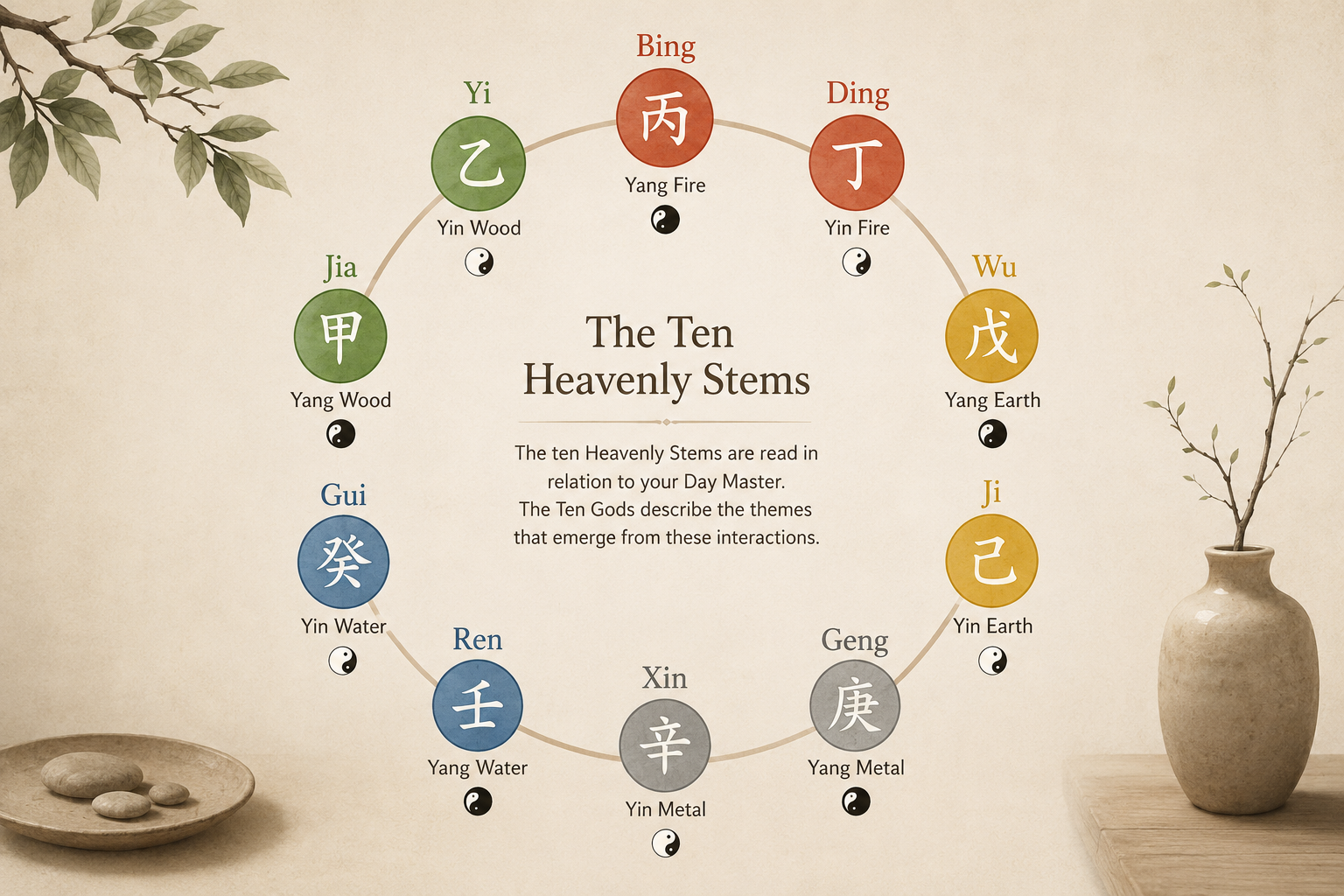
The ten Heavenly Stems are Jia, Yi, Bing, Ding, Wu, Ji, Geng, Xin, Ren, and Gui. Each stem has one of the five elements and a yin/yang polarity:
- Jia Yang Wood, Yi Yin Wood, Bing Yang Fire, Ding Yin Fire, Wu Yang Earth, Ji Yin Earth, Geng Yang Metal, Xin Yin Metal, Ren Yang Water, Gui Yin Water.
In a BaZi chart, your Day Master is the Heavenly Stem of your day pillar. All other stems and branches are read in relation to that stem. The Ten Gods are the relational labels that emerge from these interactions. They describe themes like support, expression, responsibility, resources, and peer pressure—not fixed rewards or punishments.
The 2027 Pillar: Ding Wei
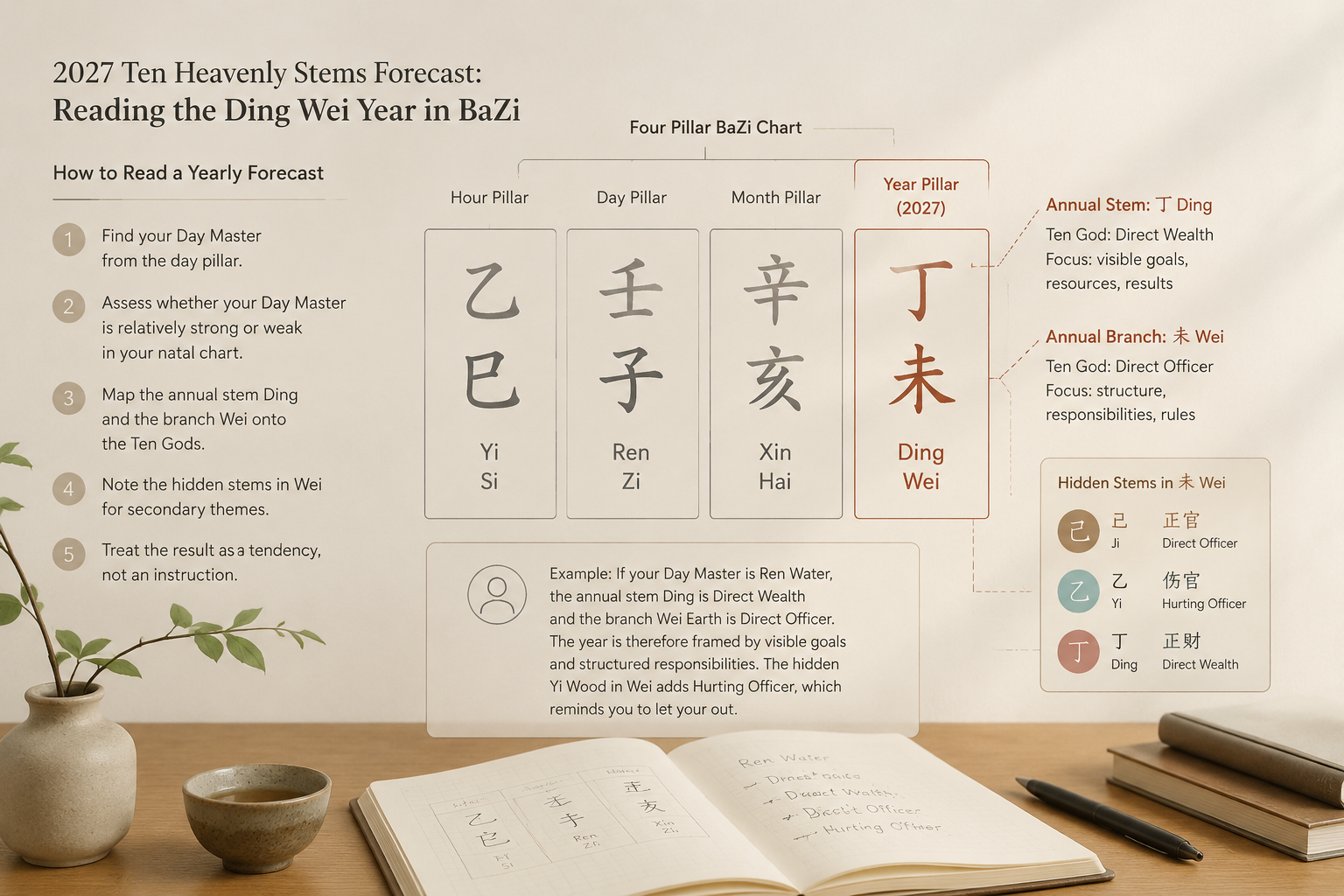
2026 is a Bing Wu year, and 2027 moves to Ding Wei. Ding is Yin Fire, the energy of a lamp or candle flame. Wei is the Goat, a Yin Earth branch. In traditional BaZi, Wei contains three hidden stems: Ji Earth as the main qi, Ding Fire as the middle qi, and Yi Wood as the residual qi.
This means 2027 is primarily an Earth year with a warm Fire ember and a hidden Wood root. Because the year pillar is one of four pillars, it represents the annual environment around your chart. It does not replace your month, day, hour, or luck cycles. The annual pillar is one layer of interpretation.
How to Read a Yearly Forecast
To use this article well, start with a full BaZi chart rather than your zodiac sign. The reading path has five steps:
- Find your Day Master from the day pillar.
- Assess whether your Day Master is relatively strong or weak in your natal chart.
- Map the annual stem Ding and the branch Wei onto the Ten Gods.
- Note the hidden stems in Wei for secondary themes.
- Treat the result as a tendency, not an instruction.
For example, if your Day Master is Ren Water, the annual stem Ding is Direct Wealth and Wei Earth is Direct Officer. The year is therefore framed by visible goals and structured responsibilities. The hidden Yi Wood in Wei adds Hurting Officer, which reminds you to let your output speak. Every Day Master follows the same logic.
The Ten Day Masters in the 2027 Ding Wei Year
The table below shows the main Ten God relationships for the annual stem Ding and the main qi of Wei, Ji Earth. The hidden Yi Wood column is included because it is the residual qi inside Wei.
| Day Master | Ding (stem) | Ji Earth (main qi of Wei) | Hidden Yi Wood |
|---|---|---|---|
| Jia Wood | Shang Guan | Zheng Cai | Jie Cai |
| Yi Wood | Shi Shen | Pian Cai | Bi Jian |
| Bing Fire | Jie Cai | Shang Guan | Zheng Yin |
| Ding Fire | Bi Jian | Shi Shen | Pian Yin |
| Wu Earth | Zheng Yin | Jie Cai | Zheng Guan |
| Ji Earth | Pian Yin | Bi Jian | Qi Sha |
| Geng Metal | Zheng Guan | Zheng Yin | Zheng Cai |
| Xin Metal | Qi Sha | Pian Yin | Pian Cai |
| Ren Water | Zheng Cai | Zheng Guan | Shang Guan |
| Gui Water | Pian Cai | Qi Sha | Shi Shen |
Jia Wood (甲)
For Jia Wood, Ding is Shang Guan (Hurting Officer) and Wei is Zheng Cai (Direct Wealth). Hidden Yi Wood appears as Jie Cai (Rob Wealth). This is an output-and-resource year: expression, creative work, and daily production are visible, but the earthy branch asks you to manage budgets and peer dynamics. A strong Jia can use this energy consistently. A weaker Jia should avoid over-expanding and rely on hidden support rather than force.
Yi Wood (乙)
Ding is Shi Shen (Eating God), Ji Earth is Pian Cai (Indirect Wealth), and hidden Yi is Bi Jian (Friend). This combination supports applied creativity, flexible income ideas, and learning by doing. Peers and collaborators may be more present. Strong Yi Wood can turn practice into tangible value. Weaker Yi Wood should choose fewer projects and protect its root.
Bing Fire (丙)
Ding is Jie Cai (Rob Wealth), Wei is Shang Guan (Hurting Officer), and hidden Yi is Zheng Yin (Direct Resource). The year can feel social, expressive, and lively, yet Wei Earth consumes Fire. If your Bing Fire is strong, the outlet can be productive. If it is weak, the same expression may feel draining. Use the hidden Direct Resource for structured learning, and keep a simple pace.
Ding Fire (丁)
Ding meets Bi Jian (Friend), Wei is Shi Shen (Eating God), and hidden Yi is Pian Yin (Indirect Resource). This is a year of self-identification and quiet output. Because the annual stem matches your Day Master, your choices may feel more visible. Strong Ding Fire can use the steady light for consistent practice. Weak Ding Fire should focus on rhythm and rest, not dramatic changes.
Wu Earth (戊)
Ding is Zheng Yin (Direct Resource), Ji Earth is Jie Cai (Rob Wealth), and hidden Yi is Zheng Guan (Direct Officer). This is a learning-and-responsibility year. Formal knowledge, mentors, roles, and external expectations sit alongside peer movement and shared resources. Strong Wu Earth can absorb the pressure and build a stable reputation. Weak Wu Earth should protect time before accepting obligations.
Ji Earth (己)
Ding is Pian Yin (Indirect Resource), Ji Earth is Bi Jian (Friend), and hidden Yi is Qi Sha (Seven Killings). This year brings informal learning and a larger circle, but also quiet pressure to move deeper. The same support network can feel demanding. Strong Ji Earth can use community to finish projects. Weak Ji Earth should limit its circle and rest more often.
Geng Metal (庚)
Ding is Zheng Guan (Direct Officer), Ji Earth is Zheng Yin (Direct Resource), and hidden Yi is Zheng Cai (Direct Wealth). This is a role-and-preparation year: responsibility, structure, and external evaluation appear, with training or institutional support behind them. Strong Geng Metal can build a solid reputation. Weak Geng Metal should take on fewer public commitments and ask for help earlier.
Xin Metal (辛)
Ding is Qi Sha (Seven Killings), Ji Earth is Pian Yin (Indirect Resource), and hidden Yi is Pian Cai (Indirect Wealth). The year can feel fast and reactive. Deadlines and sudden obligations may appear. Indirect Resource offers unconventional tools and mentors; Indirect Wealth opens side paths. Strong Xin can let pressure sharpen its skill. Weak Xin should create simple safeguards and avoid over-committing.
Ren Water (壬)
Ding is Zheng Cai (Direct Wealth), Ji Earth is Zheng Guan (Direct Officer), and hidden Yi is Shang Guan (Hurting Officer). This points to visible goals, performance expectations, and structured opportunities. The year may feel like an evaluation. Strong Ren Water can use the structure to produce strong work. Weak Ren Water should manage workload and avoid judging itself only through external results.
Gui Water (癸)
Ding is Pian Cai (Indirect Wealth), Ji Earth is Qi Sha (Seven Killings), and hidden Yi is Shi Shen (Eating God). This is a dynamic, restless mix: side opportunities appear, but they carry urgency and risk. The hidden Shi Shen grounds the year through craft, routine, and honest expression. Strong Gui can move quickly with intention. Weak Gui should reduce risk and return to core skills.
Limitations of an Annual Stem Reading
BaZi is a cultural reference and a structured reading method, not a scientific prediction system. The annual pillar is only one of eight characters in your full chart. Two people with the same Day Master may experience the year differently because their month, day, hour, and luck cycles change the overall balance.
Use this forecast as a starting point for reflection, not as financial, medical, or legal advice. The Ten Gods describe relationships between elements; they do not command specific outcomes. A calm, methodical reading is more useful than a dramatic one.
FAQ
When does the 2027 Ding Wei year begin in BaZi?
In BaZi, the new annual pillar begins at Li Chun, the first solar term, which falls around February 4, 2027. This is not the same as January 1 or the lunar New Year. If your birthday falls before Li Chun, a BaZi chart still uses the previous year’s stems.
What is the Heavenly Stem for 2027?
The Heavenly Stem is Ding, Yin Fire. It is often described as a lamp or candle flame: steady, visible, and relational rather than explosive. The Earthly Branch Wei is the Goat, an Earth branch containing hidden Fire and Wood.
Can I use this article as a complete BaZi reading?
No. This article is an introductory layer. A full BaZi reading includes all four pillars, the strength of the Day Master, interactions between hidden stems, and luck cycles. Use this guide to form questions, not final answers.
Do I need to know my Day Master?
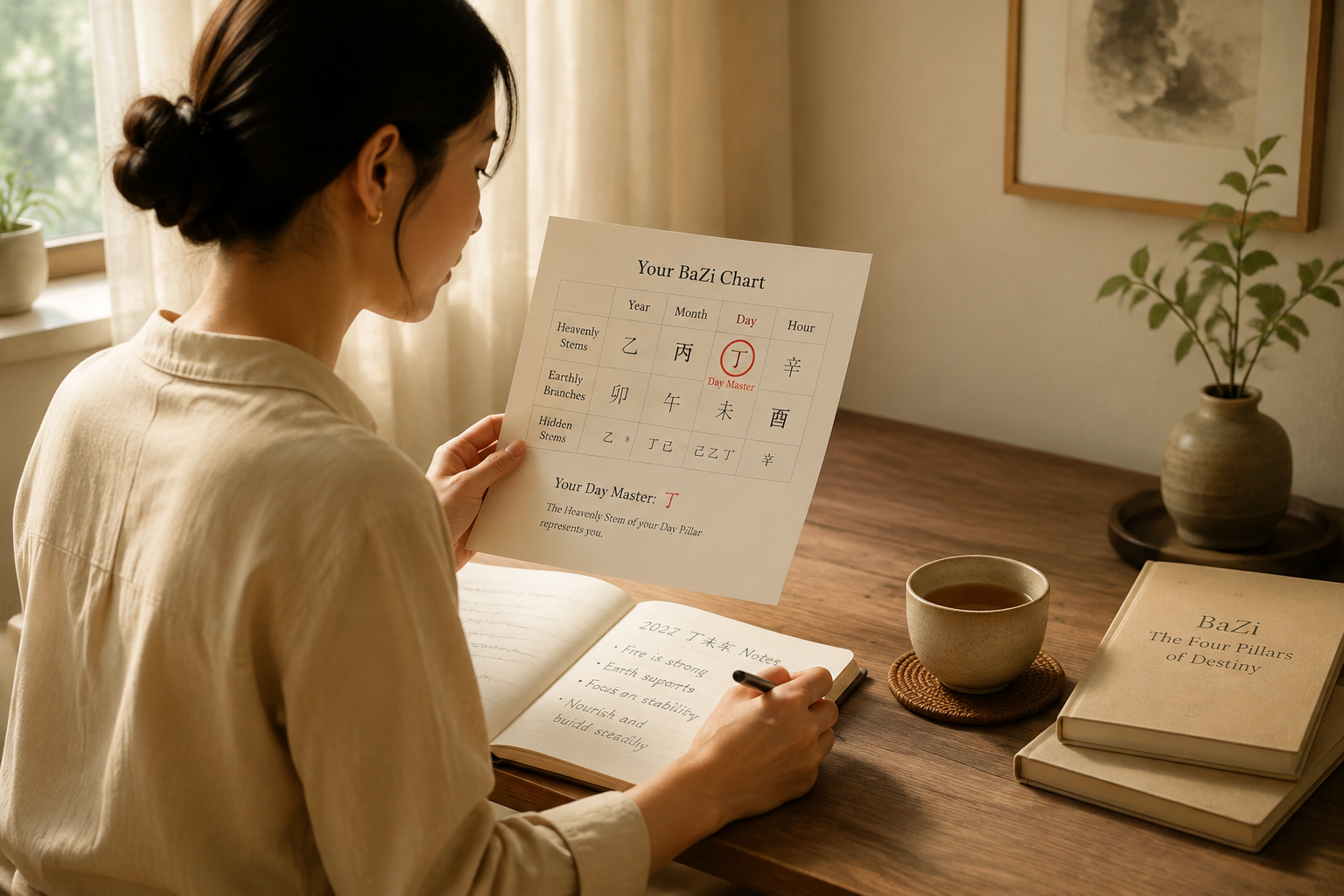
Yes. Your Day Master is the Heavenly Stem of your day pillar. If you do not know it, you can generate a free BaZi chart and find it in minutes.
Find Your Day Master for 2027
The clearest starting point is to generate your free BaZi chart and see your day pillar. You can also use the Huangli calendar to mark Li Chun and observe the daily element context. Once you know your Day Master, re-read the corresponding section above with your full chart beside you. The 2027 ten Heavenly Stems forecast is a tool for reflection, not a sentence.
Related reading
Related guide
2027 Ding Wei Year Outlook: Read the Fire Goat Year the BaZi Way
A grounded BaZi reading of the 2027 Ding Wei (Fire Goat) year. Learn what Ding and Wei mean, how the year interacts with your Day Master, and where the method stops short of prediction.
Related guide
What Is a BaZi Chart? A Beginner's Guide to the Four Pillars
Learn what a BaZi chart is, how the Four Pillars work, what the Day Master means, and how to read your chart with a clear, methodology-based approach.
Related guide
Ding Chou Day Pillar: The Hidden Spark in Your Chart
Learn how the Ding Chou day pillar works in a BaZi chart: Ding Fire on Chou Earth, hidden stems, Ten Gods, reading steps, and honest limits.